
IXXI creates design that lasts with Agfa’s SYNAPS
- Publicado el 13 de Marzo de 2026
When IXXI launched in 2010, its founders set out with the goal of making art accessible to everyone. Based in Nijmegen, the Netherlands, the company’s modular wall art system sparked a new way for people to display their favourite designs, with a product built around small, interlinkable photo cards that let customers create personalised wall decorations that can be rearranged or updated at any time.
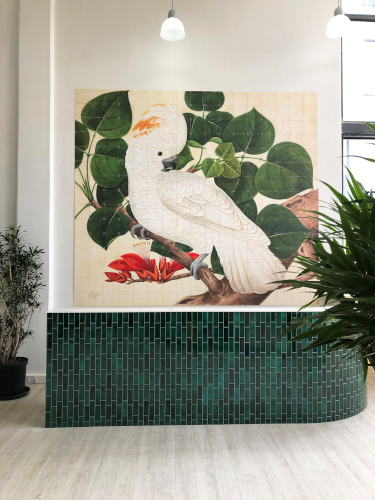
“From day one, we wanted people to be able to experience art in a new way – to make it fun, flexible, and personal,” said Erik-Jan Schreurs, Co-CEO / Owner of IXXI. “That principle shaped every design choice, including the materials we use.”
As IXXI grew from a start-up to an international brand, one material has remained at the heart of its success: Agfa’s SYNAPS synthetic paper. From the very beginning, IXXI chose SYNAPS as the foundation for its product and,15 years later, SYNAPS remains the only substrate that the company prints on.
“IXXI is all about giving people the freedom to keep playing with their wall art and make it truly their own,” said Schreurs. “SYNAPS has been part of that journey from the start, and nothing else matches its combination of quality and lasting performance.” IXXI is a modular wall art system built around two essential components: the X Tool and the I Tool. Together, these tools define IXXI’s distinctive look of clean lines and a grid structure.
What makes IXXI truly unique is its flexibility. The tiles can be printed on both sides and easily rearranged, allowing endless variations and updates. Because IXXI is double-sided and designed to be reconfigured again and again, choosing the right material was crucial to the product’s success, and this mission led IXXI to Agfa and SYNAPS.
From the earliest sample tests, SYNAPS proved the ideal match for IXXI’s vision. Its premium print surface, durability, and dimensional stability ensure the wall art cards remain perfectly flat and vibrant for years, withstanding incidental damage to keep designs looking their best.
Extensive testing confirmed that SYNAPS OM300 delivers the perfect balance of weight and thickness for IXXI’s modular design, as it is light enough to hang effortlessly yet strong enough to maintain its form over time.
“When we tested differed materials, SYNAPS immediately stood out,” Schreurs recalled. “This material had the look and feel we wanted but with the toughness to handle any challenge thrown at it. That balance is what made us really fall in love with it.”
Unlike conventional paper or rigid plastics, SYNAPS is engineered to resist tearing, moisture, and curling, while still offering excellent opacity for flawless double-sided printing. These properties preserve both the visual appeal and longevity of every IXXI creation.
“SYNAPS is the perfect base for what we create. It keeps every IXXI looking sharp, smooth, and beautifully printed. It’s what makes our products feel premium and built to last,” said Schreurs. “Our customers may not know the name ‘SYNAPS’ but they instantly feel the quality – it’s what makes an IXXI look and feel like an IXXI.”
As a result of this performance, SYNAPS has become an integral part of the IXXI brand identity. SYNAPS’ refined, silky surface enhances colour depth and image clarity, producing true-to-life art reproductions and vivid photographic prints.
“You can see and feel the quality right away,” said Schreurs. “When customers open their box we often hear them say how beautiful the print looks, and that tactile first impression comes directly from the material.”
The material's durability also offers a powerful sustainability advantage. SYNAPS enables IXXI’s customers to reuse or repurpose their wall art extending each product’s lifespan and reducing waste. This aligns perfectly with the company’s long-term goal of creating lasting, personal designs that are environmentally responsible.
“For us, sustainability is more than a checkbox,” Schreurs noted. “If our product lasts, and if people can reuse and recreate with it, that’s real sustainability in action. SYNAPS helps make that possible.”
SYNAPS’s sustainability benefits extend beyond it long lifespan however. Through a dedicated recycling program, IXXI collects production waste and returned tiles from customers, and sends them back to Agfa where the materials are turned back into new SYNAPS sheets. This closed-loop system recycling printed materials is unique in the market and forms a key part of both companies’ commitment to circularity.
As a result of this collaboration, Agfa has also been able to extensively test the recyclability of printed SYNAPS, enabling it to extend its recycling program. Four pilot schemes are currently in progress and plans are underway to broaden it extensively in 2026, helping to significantly increase the amount of reclaimed material on the market.
Behind IXXI’s success lies a collaboration that has lasted for more than a decade. Agfa provides IXXI with custom-engineered SYNAPS sheets specifically tailored for its needs. These materials are specifically built to eliminate curling and optimize dimensional stability, and as IXXI has scaled, Agfa’s consistent delivery, reliable communication, and proactive support have proven invaluable.
“Agfa’s responsiveness and technical expertise make them an invaluable partner,” said Schreurs. “For more than 15 years, our collaboration has shown that premium quality and sustainability can go hand in hand, with SYNAPS enabling both our unique design flexibility and ensuring that every wall art piece remains as vivid and precise as the day it was created.”
Jolien Staring, Business Development Manager SYNAPS at Agfa, commented: “Working with IXXI perfectly illustrates what SYNAPS stands for – creative flexibility, durability, and sustainability, in one remarkable synthetic paper. It’s rewarding to see how our material helps bring IXXI’s customers’ designs to life while supporting a more circular approach to wall art. Together, we’ve developed something that performs beautifully for customers and makes a positive impact on the planet.”